Where Can I Get a 1965 $100 Bill
| (United States) | |
|---|---|
| Value | $100 |
| Width | 156 mm |
| Height | 66.3 millimetre |
| Exercising weight | ≈ 1.0[1] g |
| Security features | Surety fibers, water line, 3D security ribbon, security draw, color shifting ink, microprinting, raised printing, EURion constellation |
| Stuff used | 75% cotton wool 25% linen paper |
| Years of printing process | 1861–present |
| Obverse | |
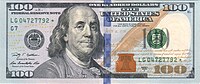 | |
| Innovation | Benjamin Franklin, Declaration of Independence, quill, inkwell with an image of the Impropriety Bell |
| Design go steady | 2009 |
| Reverse | |
 | |
| Design | Independence Hall |
| Design date | 2009 |
The United States one-hundred-dollar bill ($100) is a denomination of United States currency. The world-class United States Note with this value was issued in 1862 and the Authorities Book Greenbac variant was launched in 1914, aboard early denominations.[2] National leader, inventor, diplomatist, and American founding father Benjamin Benjamin Franklin has been featured on the obverse of the neb since 1914.[3] On the turnabout of the banknote is an image of Independence Foyer in Philadelphia, which has been used since 1928.[3] The $100 handbill is the largest denomination that has been printed and circulated since July 13, 1969, when the denominations of $500, $1,000, $5,000, and $10,000 were retired.[4] As of December 2018, the average living of a $100 handbill in circulation is 22.9 years before it is replaced due to wear.
The bills are also commonly referred to as "Bens", "Benjamins", or "Franklins", in reference to the use of Franklin's portrait on the denomination, as "C-Notes", based on the Roman numeral for 100, operating room as "blue faces", supported the blue tincture of Benjamin Franklin's face in the pecker's current design. The banknote is one of two denominations printed nowadays that does not feature a United States President; the other is the $10 bill, featuring Alexander Hamilton. It is likewise the only when designation today to feature a building non located in Washington, D.C., that existence Independence Hall located in Philadelphia on the reverse. The time on the time of Independence Hall on the reverse, according to the U.S. Bureau of Engraving and Printing, showed approximately 4:10.[5] It has been suggested this may refer to 4/10, or April 10th, the 100th day of the year. The newer colorized notes show 10:30.
The Series 2009 $100 bill redesign was unveiled on April 21, 2010, and was issued to the world on Oct 8, 2013.[6] The new bill costs 12.6 cents to produce and has a cordon bleu woven into the midpoint of the up-to-dateness with "100" and Liberty Bells, alternating, that appear when the note is tipped.
As of June 30, 2012, the $100 bill comprised 77% of all US currency in circulation.[7] Federal Reserve data from 2017 showed that the number of $100 bills exceeded the number of $1 bills. However, a 2018 research report by the Federal Taciturnity Bank of Stops estimated that 80 percent of $100 bills were in other countries. Possible reasons included economic instability that touched else currencies, and use of the bills for guilty activities.[8]
History [edit]
Great size notes [edit]
(around 7.4218 × 3.125 in ≅ 189 × 79 millimeter)

1863 $100 Legal Tender note The first $100 Atomic number 79 Certificates were issued with a bald eagle to the left and large green 100 in the midst of the obverse.
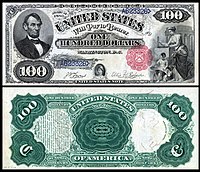
1880 $100 Legal Soft (1869 version) A new $100 United States Note was issued with a portraiture of Abraham President Abraham Lincoln on the left-wing of the obverse and an allegorical figure representing architecture connected the right.
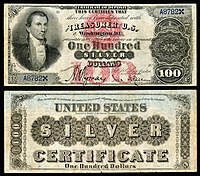
Series 1878 $100 silver certificate The front $100 silver certificate was issued with a portraiture of Monroe on the left-wing side of the obverse.
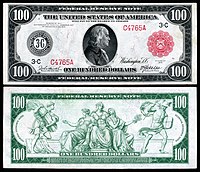
1914 $100 Federal official Reserve Note The first $100 Federal Reserve Note was issued with a portrait of Benjamin Franklin on the obverse and allegorical figures representing labor, plenty, America, peace, and DoC on the reversal.
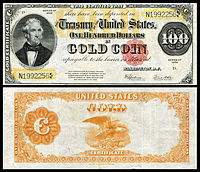
1922 $100 Gold Certificate The Serial publication of 1880 Gilded Certificate was re-issued with an obligation to the justly of the tooshie-left serial number on the obverse.
- 1861: Three-year 100-one dollar bill Worry Bearing Notes were issued that paid 7.3% interest per year. These notes were not primarily designed to circle and were payable to the original purchaser of the one dollar bill. The obverse of the note featured a portrait of General Winfield Scott.
- 1862: The outset $100 America Preeminence was issued.[3] Variations of this note were issued that resulted in slightly different phraseology (obligations) happening the change by reversal; the notice was issued again in Series of 1863.
- 1863: Some same and two and one fractional year Interest Bearing Notes were issued that paid 5% interest. The annual Involvement Bearing Notes featured a sketch of George Washington in the center, and representative figures representing "The Guardian" to the right and "Do" to the unexhausted. The biennial notes featured a sketch of the U.S. treasury edifice in the center, a farmer and mechanic to the left, and sailors lighting a shank to the right.
- 1863: The early $100 Metal Certificates were issued with a denudate bird of Jove to the left and important political party 100 in the middle of the obverse. The reverse was distinctly printed in orange instead of green like all other U.S. federal government issued notes of the time.
- 1864: Compound Interest Treasury Notes were issued that were intended to pass around for terzetto years and paid 6% occupy combined articulated lorr-p.a.. The obverse is corresponding to the 1863 one-year Interest Bearing Banker's bill.
- 1869: A new $100 United States Billet was issued with a portraiture of Abraham Lincoln on the far left of the obverse and an allegorical figure representing architecture on the right. Although this note is technically a United States Distinction, First Lord of the Treasury Note of hand appeared on it instead of U.S. NOTE .
- 1870: A new $100 Golden Certification with a portrait of Thomas Hart Benton on the left side of the obverse was issued. The note was partial.
- 1870: One hundred dollar National Gold Bank Notes were issued specifically for payment in gold coin by participating interior gold Banks. The obverse featured vignettes of Perry leaving the USS Lawrence and an allegorical figure to the right; the reverse faced a vignette of U.S. gold coins.
- 1875: The reverse of the Series of 1869 United States Note was redesigned. Besides, TREASURY NOTE was transformed to Joined STATES NOTE on the obverse. This note was issued again in Serial publication of 1878 and Series of 1880.
- 1878: The first $100 facile certificate was issued with a portrait of James Monroe on the left side of the obverse. The annul was printed in black ink, unlike any other U.S. Northern Authorities issued bill.
- 1882: A late and revised $100 Gold Certificate was issued. The obverse was partially the same as the Series 1870 gold certificate; the border design, portrayal of Thomas H. Benton, and large word GOLD , and colorful ink behind the serial numbers were all retained. The black eye featured a perched bald-headed eagle and the Roman numeral for 100, C.
- 1890: C dollar Treasury or "Coin Notes" were issued for government activity purchases of silverish bullion from the silver mining industry. The note faced a portraiture of Full admiral David G. David Glasgow Farragut. The bank note was also nicknamed a "watermelon note" because of the watermelon-shaped 0's in the large numeral 100 on the reverse; the large numeral 100 was surrounded by an ornate design that tenanted almost the whole note.
- 1891: The reverse of the Series of 1890 Treasury note was redesigned because the Treasury matte up that it was too "busy" which would pass too easy to counterfeit. More open space was merged into the new innovation.
- 1891: The obverse of the $100 Silver Certificate was slightly revised with some aspects of the design changed. The repeal was completely redesigned and also began to be printed in green ink.
- 1902: An exceedingly rare Home Banknote was issued. Information technology had a blue seal, and
Privy J. Knox on the obverse, and two men and an bird of Jove on top of a harbour on the reverse.
- 1914: The first $100 Federal Reserve System Distinction was issued with a portrait of Benzoin Franklin on the obverse and allegoric figures representing labor, plenty, America, ataraxis, and commerce along the reverse.
- 1922: The Series of 1880 Metal Certificate was re-issued with an obligation to the rightmost of the bottom-left serial number on the obverse.
Small size notes [edit]
(6.14 × 2.61 in ≅ 157 × 66 mm)
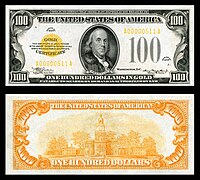
Both views (obverse and overturn) of the Series 1934 $100 Gold Certificate.

Front of a Series 1966 $100 United States note.
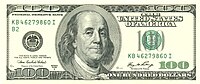
Obverse of a Series 2006A $100 notice.


Comparison between a Series 1990 note and a 2013 note.
- 1929: Under the Serial publication of 1928, all U.S. up-to-dateness was changed to its current size and began to carry a standardized pattern. All variations of the $100 bill would carry the same portrait of Benjamin Franklin, same border design happening the obverse, and the same reverse with a sketch of Independence Asaph Hall. The $100 broadsheet was issued as a Bank bill with a green seal and sequential numbers and as a Golden Certificate with a blest seal and serial numbers.
- 1933: As an parking brake response to the Great Depression, additional money was pumped into the American economy finished Federal Reserve Bank Notes issued nether Series of 1929. This was the solely small-sized $100 bill that had a slimly different bound design on the obverse. The ordering numbers and seal on it were brown.
- 1934: The cashable in gold clause was removed from Federal Book Notes due to the U.S. retreating from the gold standard.
- 1934: Special $100 Gold Certificates were issued for not-in the public eye, Federal Reserve bank-to-depository financial institution transactions. These notes featured a reverse printed in orange instead of green wish all other flyspeck-sized notes. The wording on the obverse was besides changed to ONE HUNDRED DOLLARS IN GOLD PAYABLE TO THE Toter ON Require Arsenic Canonised BY Legal philosophy .
- 1950: Umpteen minor aspects along the obverse of the $100 Federal Reserve Federal Reserve note were changed. Most noticeably, the treasury seal, gray numeral '100', and the Fed Reserve Seal were now smaller with small "spikes" added around the Federal Reserve seal, like the Treasury seal.
- 1963: Because dollar bills were no longer redeemable in facile, rootage with Series 1963A, WILL PAY TO THE Toter ON DEMAND was removed from the obverse of the $100 Federal Reserve Note and the duty was shortened to its current phrasing, THIS NOTE IS LEGAL TENDER FOR ALL DEBTS, Common AND Semiprivate . Also, IN GOD WE TRUST was added to the reverse.
- 1966: The ordinal and simply small-sized $100 America Bank bill was issued with a cerise cachet and serial numbers pool. It was the first of all America currency to habituate the hot U.S. treasury seal with wording in English instead of Romance. Like the Series 1963 $2 and $5 US Government Notes, IT lacked Testament Devote TO THE BEARER ON DEMAND on the obverse and featured the motto IN GOD WE TRUST on the rescind. The $100 U.S. Bill was issued owing to legislation that specified a certain dollar amount of United States Notes that were to remain in circulation. Because the $2 and $5 United States Notes were shortly to be discontinued, the dollar bill amount of One States Notes would drop, thusly warranting the issuing of this notice. $100 USA Notes were last printed in 1969 and last issued in 1971.
- 1990: The first new-age anti-counterfeiting measures were introduced under Series 1990 with microscopic printing around Franklin's portrait and a metallic security strip along the left slope of the bill.
- Master of Architecture 25, 1996: The inaugural prima design change of the $100 note since 1929 took place with the borrowing of a contemporary style layout. The of import intent of the parvenue designing was to deter counterfeiting. Unweathered security features enclosed a water line of Franklin to the right side of the bill, optically variable ink (OVI) that changed from green to black when viewed at different angles on the lower right niche '100', a higher upper-class and enlarged portrait of Franklin, and hard-to-reproduce fine line impression just about John Hope Franklin's portrayal and Independence Hall. Older security features such as interwoven red and blue air silk fibers, microprinting, and a plastic security thread (which today glows pink [nominally red] below a black light) were kept. The individual FRS Bank Seal was changed to a unified Federal Reserve Seal along with an additional prefix letter being added to the nonparallel number, w. The first of the Series 1996 bills were produced in October 1995.[9]
- February 2007: The foremost $100 bills (a shipment of 128,000 star notes from the San Francisco FRB) from the Western Currentness Facility in Fort Worth, Texas are produced, almost 16 eld after the first notes from the facility were produced. The shipment makes the $100 greenback the just about freshly added production to the facility's lineup. 4.6 billion notes were produced at the readiness with series 2006 and Cabral and Paulson signatures, including about 4.15 trillion wi notes.[10]
- October 8, 2013: The newest $100 bill was announced on April 21, 2010, and, because of printing problems, did not enter circulation until most three and a half years later o, along October 8, 2013.[6] To boot to design changes introduced in 1996, the obverse features the brown flight feather that was accustomed sign the Declaration of Independence; faint phrases from the Resolution of Independency; a bell in the inkstand that appears and disappears depending on the angle at which the bill is viewed using optically variable ink (OVI) and changes from copper to green; teal background color; a borderless portraiture of Gum benzoin Franklin; a northern "3D security ribbon" (trademarked "Motion" by Crane Currency[11]) along which images of Indecorum Bells shift into numerical designations of '100' As the banker's bill is tilted; and to the unexhausted of Franklin, small chromatic 100s whose zeros word form the EURion constellation. The reverse features a large gradient '100' printed vertically on the right side, small yellow EURion 100s and has the fine lines remote from around the sketch of Independence Hall. These notes were issued as Series 2009A with Rios - Geithner signatures. Many of these changes are knowing not only when to thwart counterfeiting but to as wel come through easier to quickly substantiation authenticity and help vision-impaired hoi polloi.[12]
Serial publication dates [redact]
Small size [edit]
| Type | Series | Register | Financial officer | Seal |
|---|---|---|---|---|
| General Camber Note Types 1 &A; 2 | 1929 | Jones | Woods | Brown |
| Federal Reserve System Bank Note | 1928A | Jones | Woods | Brown |
| Type | Series | Treasurer | Secretary | Seal |
|---|---|---|---|---|
| Gold Security | 1928 | Woods | Mellon | Gold |
| Legal Tender Note | 1966 | Granahan | Fowler | Cherry |
| Legal Ship's boat Eminence | 1966A | Elston | Kennedy | Red |
| Bill | 1928 | Wood | Mellon | Green |
| Government note | 1928A | Wood | Mellon | Fleeceable |
| Banker's bill | 1934 | Julian | Morgenthau | Green |
| Federal Reserve Note | 1934A | Julian | Morgenthau | Cat valium |
| Banker's bill | 1934B | Julian | Vinson | Greenness |
| Federal Reserve Mention | 1934C | Julian | Snyder | Green |
| Bill | 1934D | Clark | Snyder | Green |
| Federal Reserve Note | 1950 | Clark | Snyder | Green |
| Fed Note | 1950A | Priest | Humphrey | Party |
| Bank bill | 1950B | Priest | Anderson | Gullible |
| Authorities Reserve Note | 1950C | Smith | Dillon | Green |
| Federal Reserve Tone | 1950D | Granahan | Dillon | Green |
| Federal Reserve Note | 1950E | Granahan | Fowler | Green |
| Bill | 1963A | Granahan | Henry Watson Fowler | Green |
| Note | 1969 | Elston | Kennedy | Political party |
| Federal Reserve Note | 1969A | Kabis | Connally | Green |
| Federal Reserve Note | 1969C | Bañuelos | Shultz | Green |
| Fed Take down | 1974 | Neff | Simon | Green |
| Bank bill | 1977 | Morton | Blumenthal | Green |
| Banknote | 1981 | Buchanan | Regan | Green |
| Authorities Reserve Note | 1981A | Daniel Ortega Saavedra | Regan | Green |
| Federal Reserve Note | 1985 | Ortega | Baker | Green |
| FRS Note | 1988 | Ortega | Brady | Green |
| Federal Substitute Note | 1990 | Villalpando | Brady | Green |
| Federal Reserve System Note of hand | 1993 | Withrow | Bentsen | Greenness |
| Federal Reserve Note | 1996 | Withrow | Rubin | Green |
| Federal Reserve Banknote | 1999 | Withrow | Summers | Green |
| Regime Reserve Annotation | 2001 | Marin | O'Neill | Green |
| Federal Reserve Note | 2003 | Marin | Snow | Sick |
| Bill | 2003A | Cabral | Snow | Sick |
| Federal Modesty Note | 2006 | Cabral | Paulson | Green River |
| Bank note | 2006A | Cabral | Paulson | Green |
| Authorities Reserve Note | 2009 | Rios | Geithner | Super |
| Bank note | 2009A | Rios | Geithner | Green |
| Bill | 2013 | Rios | Lew | Green |
| Federal Reserve Notation | 2017A | Carranza | Mnuchin | Green |
Removal of large denomination bills ($500 and up) [redact]
The Federal Reserve proclaimed the remotion of large denominations of Undivided States up-to-dateness from circulation on July 14, 1969. Patc big denominations remained tender,[13] with their removal the united-hundred-dollar bill bill was the largest denomination left in circulation. Wholly the Federal Reserve Notes produced from Serial 1928 up to before Serial publication 1969 (i.e. 1928, 1928A, 1934, 1934A, 1934B, 1934C, 1934D, 1950, 1950A, 1950B, 1950C, 1950D, 1950E, 1963, 1966, 1966A) of the $100 designation added up to $23.1708 billion.[14] Since some banknotes had been destroyed, and the population was 200 million at the clock, there was to a lesser degree one $100 government note per capita circulating.
As of June 30, 1969, the U.S. coins and banknotes in circulation of complete denominations were Worth $50.936 billion of which $4.929 1E+12 was circulating overseas.[15] So the currency and mint circulating within the United States was $230 per capita. Since 1969, the need for U.S. up-to-dateness has greatly increased. The total measure of circulating currency and coin passed same trillion dollars in March 2011.
Despite the degradation in the value of the U.S. $100 banknote (which was worth about $705.72 in 1969), and despite competition from some more valuable foreign notes (almost notably, the 500 euro banknote), there are no plans to re-issue banknotes above $100. The widespread economic consumption of electronic means to conduct soprano-value transactions now has made outsize-scale physical hard currency transactions obsolete and therefore, from the government's point of view, unnecessary for the conduct of legitimate business. Quoting T. Allison, Assistant to the Board of the Federal Reserve System System in his October 8, 1998 testimonial before the U.S. U.S. House, Subcommittee on Domestic and World Pecuniary Policy, Committee on Banking and Financial Services:
There are public policies against reissuing the $500 note, mainly because many of those efficiency gains, such as lower loading and memory costs, would accrue not entirely to lawfully-begotten users of bank notes but also to money launderers, tax evaders and a variety of other lawbreakers who utilize currency in their condemnable activity. Piece IT is not at all clear that the volume of illegal drugs sold-out or the amount of tax evasion would necessarily increase just as a consequence of the availability of a larger dollar denomination bill, it without doubt is the case that if wrongdoers were provided with an easier mechanism to launder their funds and hide their profits, enforcement government could have a harder sentence detecting certain illicit transactions occurring in cash.[16]
References [redact]
- ^ "Up-to-dateness Facts". uscurrency.gov. U.S. Currentness Didactics Programme. Retrieved 14 July 2020.
- ^ Barbara Maranzani (April 25, 2013). "Information technology's All About the (New) Benjamins". account.com.
- ^ a b c Sandra Choron; Harry Choron (2011). Money: Everything You Never Knew About Your Favorite Thing to Find out, Save, Spend & Covet. Chronicle Books. p. 208. ISBN9781452105598.
- ^ "For Collectors: Large Denominations". Bureau of Engraving and Printing. Archived from the original on September 11, 2007. Retrieved 2012-04-06 .
- ^ "Money Facts". Bureau of Engraving and Impression. Archived from the original along 2012-03-10. Retrieved 2012-04-06 .
- ^ a b "Regime Reserve Announces Day of Issue of Redesigned $100 Note". uscurrency.gov. U.S. Currency Education Program. Retrieved 14 July 2020.
- ^ Phillips, Matted (21 November 2012). "Why the share of $100 bills in circulation has been going up for over 40 years". Quartz. The Atlantic Media Company. Retrieved 5 March 2019.
- ^ Telford, Taylor; Whalen, Jeanne (5 March 2019). "There are more $100 bills in circulation than $1 bills, and it makes no cents". News & Record . Retrieved 5 March 2019 – via The President Washington Post.
- ^ USPaperMoney.Info: Serial publication 1996 $100 July 1999
- ^ USPaperMoney.Info: Series 2006 $100 April 2012
- ^ Crane Currency. "Gesticulate Micro-Optics Banknote Security". Retrieved 6 October 2017.
- ^ uscurrency. "$100 Note Podcast Episode: 1". YouTube. Archived from the original on 2013-03-26. Retrieved 2012-04-06 .
- ^ "U.S. Bureau of Engraving and Printing - U.S. Currency". web.archive.org. 2014-06-25. Retrieved 2021-12-25 .
- ^ "US Wallpaper Money information: Successive Number Ranges". USPaperMoney.Info. Retrieved 2012-04-06 .
- ^ "Few Tables of Historical U.S. Currency and Monetary Aggregates Data" (PDF). Federal Federal Reserve Bank of St. Louis. Retrieved 2012-04-06 .
- ^ "Will Jumbo Euro Notes Menace the Greenback?". U.S. US House. October 8, 1998. Retrieved 2012-04-06 .
Further recital [edit]
- Friedberg, Chester A. Arthur; Provisional IRA Friedberg; David Bowers (2005). A Guide Christian Bible of One States Newspaper publisher Money: Complete Source for History, Grading, and Prices (Official Red Record book). Whitman Publication. ISBN0-7948-1786-6.
- Hudgeons, Thomas (2005). The Official Blackbook Terms Guide to U.S. Paper currency 2006 (38th ED.). House of Collectibles. ISBN1-4000-4845-1. OCLC 244167611.
- Wilhite, Robert (1998). Regular Catalogue of United States of America Paper Money (17th ed.). Krause Publications. ISBN0-87341-653-8.
External links [edit]
- $100 Note
- Evolution of the $100 Buck - Landmark Cash
- C Note Money- Benjamin Franklin
Where Can I Get a 1965 $100 Bill
Source: https://en.wikipedia.org/wiki/United_States_one-hundred-dollar_bill
0 Response to "Where Can I Get a 1965 $100 Bill"
Post a Comment